

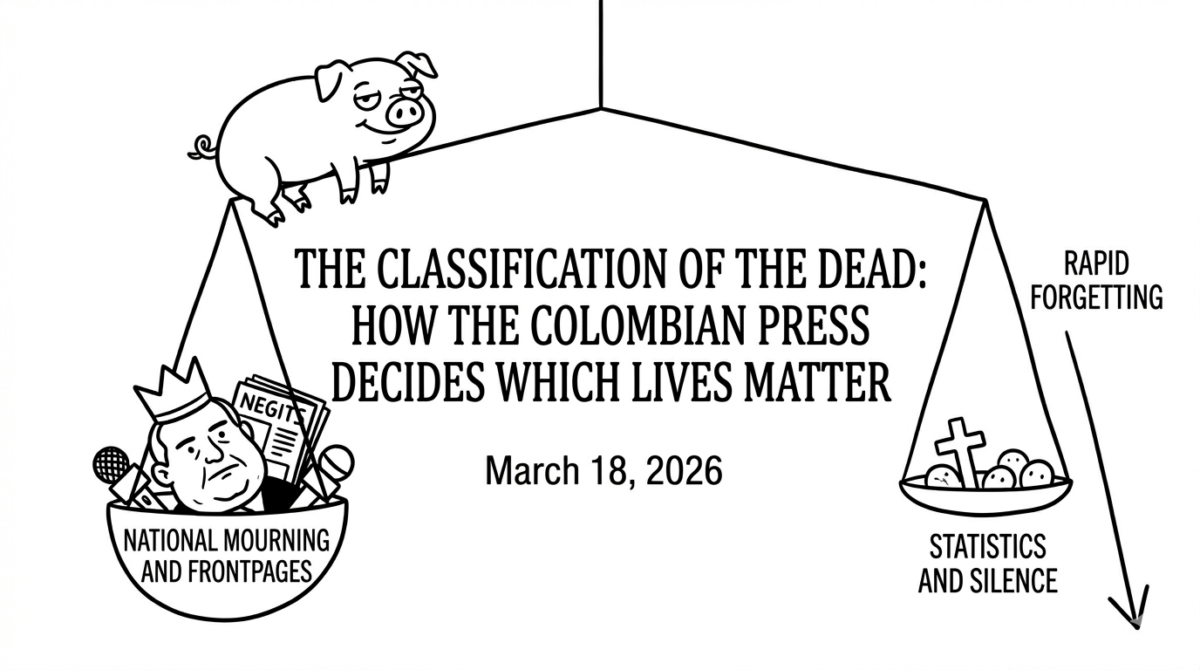
# The Classification of the Dead: How Colombian Media Decides Which Lives Matter
The elite never die in silence
On June 7, 2025, Miguel Uribe Turbay, a senator of the Republic and grandson of former president Julio César Turbay Ayala, was shot in the head at a political rally in Bogotá. He died two months later, on August 11, 2025.
The news stopped the country. Every outlet in Colombia led with his face. Magazine covers, TV specials, tributes in Congress, condolences from the entire political class. Semana, El Tiempo, Caracol, RCN: days of wall-to-wall coverage. His widow, María Claudia Tarazona, became a public figure. Her political moves still make headlines today, almost a year later.
His death was a national tragedy. And it was.
What’s uncomfortable is asking: what makes one death that, and another just a number?
Germán Vargas Lleras: even the dogs made the front page
Former vice president Germán Vargas Lleras passed away a few days ago. His death filled every available space in the media. Semana ran: “Toño and Henry: the moving image of Germán Vargas Lleras’s dogs saying goodbye to his coffin.” There were articles about his first wife, his daughter Clemencia, his romantic relationships. Profiles, chronicles, political analysis. President Petro declared a national day of mourning.
None of this is wrong. Vargas Lleras was a major figure. He deserved recognition. But the contrast with what happens to other deaths on the same day is brutal.
Camilo Espinosa Vanegas: the councilman who was nobody
On June 16, 2025 — six days after Miguel Uribe Turbay was shot — Juan Camilo Espinosa Vanegas, a councilman from San Andrés de Cuerquia (Antioquia), 32 years old, living with a disability and reduced mobility, was shot three times by a hitman as he walked home.
The story appeared on Infobae and Semana. A couple of articles. A video of the crime circulating on social media. Then silence.
No TV specials. No tributes in Congress. No opinion columns running for a week. No analysis of his political career, his dreams, his family. Camilo Espinosa was a councilman from a small town in Antioquia, a member of the AICO political movement (Indigenous Authorities of Colombia). He wasn’t a former president’s grandson. He wasn’t running for president. His death didn’t move the national agenda.
But his mother also lost a son.
Mateo Pérez Rueda: the journalist buried twice
On May 8, 2026, Mateo Pérez Rueda, a young journalist, was killed in rural Briceño, Antioquia, by the Frente 36 faction of the FARC dissidents, under alias Calarcá. They didn’t just kill him: they tortured him first. The dissidents “thought he was an infiltrator and didn’t believe he was a journalist whose only weapon was El Confidente,” the community media outlet he worked for.
After killing him, they buried him to hide the crime. A commission had to negotiate to recover his body.
Mateo Pérez Rueda wasn’t a journalist for Caracol or RCN. He didn’t have a national TV show. He was a chronicler of his territory. Someone who wanted “to show the world the brutality that happens where the greed of narco-trafficking and illegal mining converge.” He died precisely for that: for going where the big outlets don’t go.
His case did get some coverage. El Tiempo published an investigation. Petro mentioned him in the national mourning decree alongside Vargas Lleras. But ask yourself how long he stayed in the headlines. How many TV specials were dedicated to him. How many columnists filled pages with his name, the way they did with Uribe Turbay or Vargas Lleras.
The mothers of Comuna 13: 24 years of silence
And then there are the invisible ones.
Operation Orion happened on October 16 and 17, 2002, in Comuna 13 of Medellín. The National Army, the Police, and paramilitary groups entered the neighborhood to “recover territorial control.” Dozens dead. Hundreds disappeared. A wound that 24 years later is still open.
The mothers of Comuna 13 have been searching for twenty-four years. They’ve dug with their own hands in La Escombrera. They’ve filed complaints, gone to court, marched, wept. The Special Jurisdiction for Peace (JEP) has the case. Bone remains have been found. But the coverage they receive doesn’t come close to what any high-profile politician gets for breathing.
There are no headlines about them. No photos of dogs saying goodbye to their children. No national mourning decrees. No one writes columns asking what it feels like to be a mother who hasn’t known where her son’s body is for two decades.
Why? Because the disappeared of Comuna 13 weren’t senators. They were young people from the poorest neighborhoods, caught in a conflict they never asked for.
The hierarchy of grief
Put these cases together and what emerges is a ladder of how we value lives in Colombia.
On the top rung: politicians, the elite. That death gets national front pages, tributes in Congress, official mourning, weeks of columns. What matters is who they were.
One step down: people with public office but no weight on the national agenda. One article, maybe two. The crime gets reported, the person gets forgotten fast. The coverage exists because of the position, not the person.
At the bottom: everyone else. Ordinary people, marginalized communities. They’re not news: they’re statistics. The death of a community journalist in Briceño or a young person from Comuna 13 doesn’t break programming. It’s another data point in the year’s homicide count.
I’m not saying politicians don’t deserve coverage. I’m saying the Colombian media system reproduces the same inequalities as the social system. And that should be embarrassing.
When a community journalist is tortured and killed for telling the truth from the territory, it should be front page news. When a disabled councilman from a small Antioquia town is executed in cold blood, it should hurt us as much as any other murder.
When a mother has been searching for her disappeared son in La Escombrera for 24 years, her struggle deserves as much space as the day’s political agenda.
Journalism’s debt
Colombian journalism has a debt outstanding: to cover deaths with the same standard of humanity, regardless of the victim’s last name.
As long as elite families receive national condolences while poor families bury their dead in silence, as long as the mothers of Comuna 13 keep digging without cameras following them, the Colombian media system will remain a mirror of the inequality it claims to fight.
Not all lives are worth the same to the media.
But they should be.