

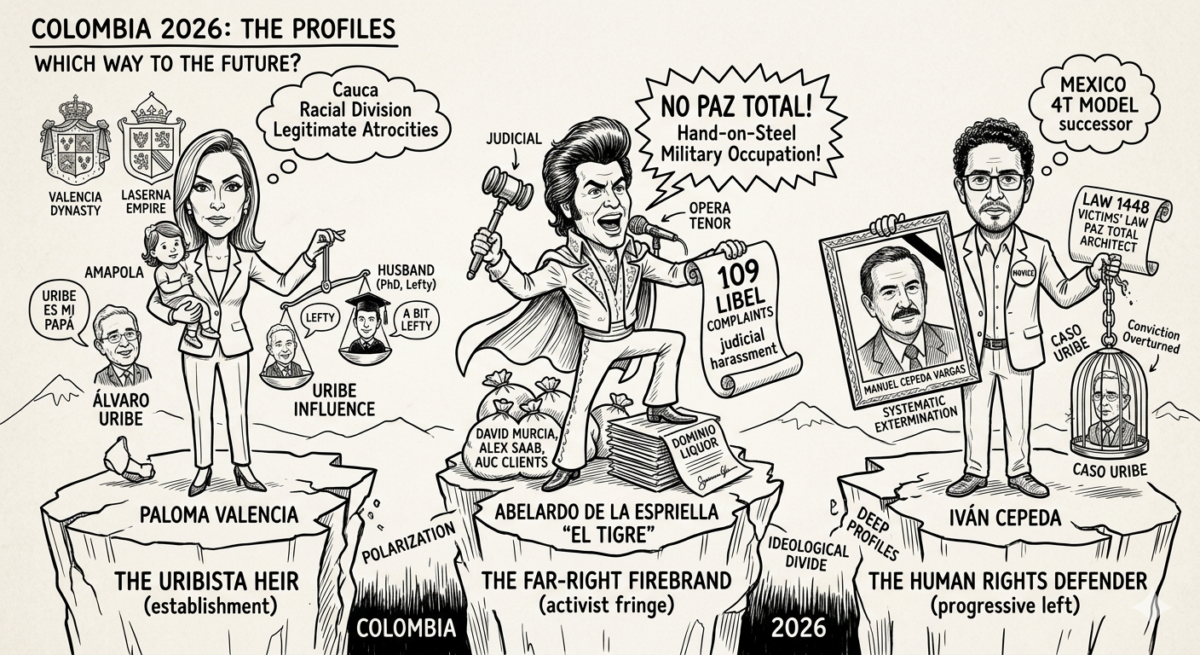
With Colombia’s 2026 presidential election approaching, voters face a critical choice between candidates with fundamentally different visions for the country’s future. This article compares the government plans of the three leading contenders — Paloma Valencia (Centro Democrático), Abelardo de la Espriella (Cambio Radical), and Iván Cepeda (Pacto Histórico) — across key policy areas.
Economic Policy
Paloma Valencia — Market Liberalization & Fiscal Discipline
Valencia’s economic platform is rooted in the free-market orthodoxy of the Centro Democrático. Her key proposals include a reduction in corporate income tax from the current 35% to 25-28%, constitutional spending caps, partial privatization of state-owned enterprises including Ecopetrol minority stakes, and a fully capitalized individual account pension system similar to Chile’s model.
Estimated fiscal impact: Valencia’s team projects these measures would reduce the fiscal deficit from 5.2% of GDP to 2.5% within four years, primarily through spending cuts and economic growth rather than tax increases.
Abelardo de la Espriella — Pragmatic Centrism
De la Espriella positions himself as a centrist focused on fiscal responsibility without ideological rigidity. His platform includes a moderate corporate tax reduction to 30%, a 50 trillion COP infrastructure plan over four years funded through public-private partnerships, and a mixed pension system combining a reformed Colpensiones with mandatory private savings (Raisalvar).
Estimated fiscal impact: De la Espriella projects deficit reduction to 3.0-3.5% of GDP, with the infrastructure plan creating an estimated 400,000 jobs.
Iván Cepeda — Progressive Expansion
Cepeda’s platform represents the most dramatic departure from current policy. He proposes significant increases in wealth tax, capital gains tax, and corporate tax on companies with profits over 1 billion COP annually, along with a 120 trillion COP social investment plan focused on healthcare, education, and rural development. He also proposes replacing the current fiscal rule with a “green fiscal rule” and creating a universal basic pension for all Colombians over 65.
Estimated fiscal impact: Independent economists estimate Cepeda’s plan would increase the deficit to 6-7% of GDP in the short term, with his team arguing that long-term growth from social investment would close the gap.
Security & Public Order
Valencia proposes tripling the police force, military patrols in major cities, mandatory minimum sentences, and expanded glyphosate fumigation. She also proposed a “Citizen Security Tax” on high-income earners.
De la Espriella advocates for an elite national investigative unit modeled on the FBI, a 50% police expansion, intelligence-led policing, and conditional fumigation with alternative development programs for coca farmers.
Cepeda calls for full implementation of the 2016 Peace Agreement, abolishing the ESMAD anti-riot police in favor of community-based conflict resolution, decriminalizing personal drug consumption, and demilitarizing internal security.
Healthcare, Education & Rural Development
On healthcare: Valencia maintains the current EPS system with stronger regulation. De la Espriella proposes strengthening ADRES to eliminate payment delays and increasing the health budget to 8.5% of GDP. Cepeda would eliminate the EPS system entirely in favor of a single public payer, nationalizing private hospitals.
On education: Valencia supports vouchers for private schools and merit-based teacher pay. De la Espriella proposes increasing education spending to 5% of GDP, building 2,000 new schools, and free university for estratos 1 and 2. Cepeda calls for free universal public education through university, eliminating the ICFES exam requirement, and tripling public university capacity.
On rural development: Valencia favors land formalization without redistribution and agribusiness promotion. De la Espriella supports land formalization with targeted distribution for conflict victims. Cepeda calls for full implementation of the Peace Agreement’s land reform — 3 million hectares distributed over 10 years — with a progressive land tax on large estates.
Climate, Foreign Policy & Analysis
On climate: Valencia prioritizes development over environmental restrictions and supports continued oil exploration. De la Espriella targets 30% renewable energy by 2035 with a 200 million tree reforestation program. Cepeda proposes an immediate halt to new oil exploration and a 15-year fossil fuel phase-out.
On foreign policy: Valencia strengthens the US alliance and opposes BRICS entry. De la Espriella pursues a balanced approach with trade agreements in Asia-Pacific. Cepeda seeks diversified relations including stronger ties with China and Russia and BRICS membership.
Conclusion
Independent fiscal analysis suggests Valencia’s plan is the most fiscally conservative but relies on optimistic growth projections. De la Espriella’s plan is the most balanced — his mixed pension system and moderate infrastructure plan could be funded without dramatic tax increases. Cepeda’s plan would require the largest tax increase in Colombian history — estimated at 8-10% of GDP in additional revenue.
None of the three campaigns has published a fully costed fiscal plan with independent verification, leaving voters to rely on campaign estimates and outside analysis.
The 2026 Colombian presidential election presents voters with three fundamentally different visions for the country’s future. Each platform has trade-offs. Colombian voters will ultimately decide which trade-offs they are willing to accept.
This comparison is based on campaign platforms, interviews, and official documents available as of May 2026. Candidates may modify their proposals before the election.