

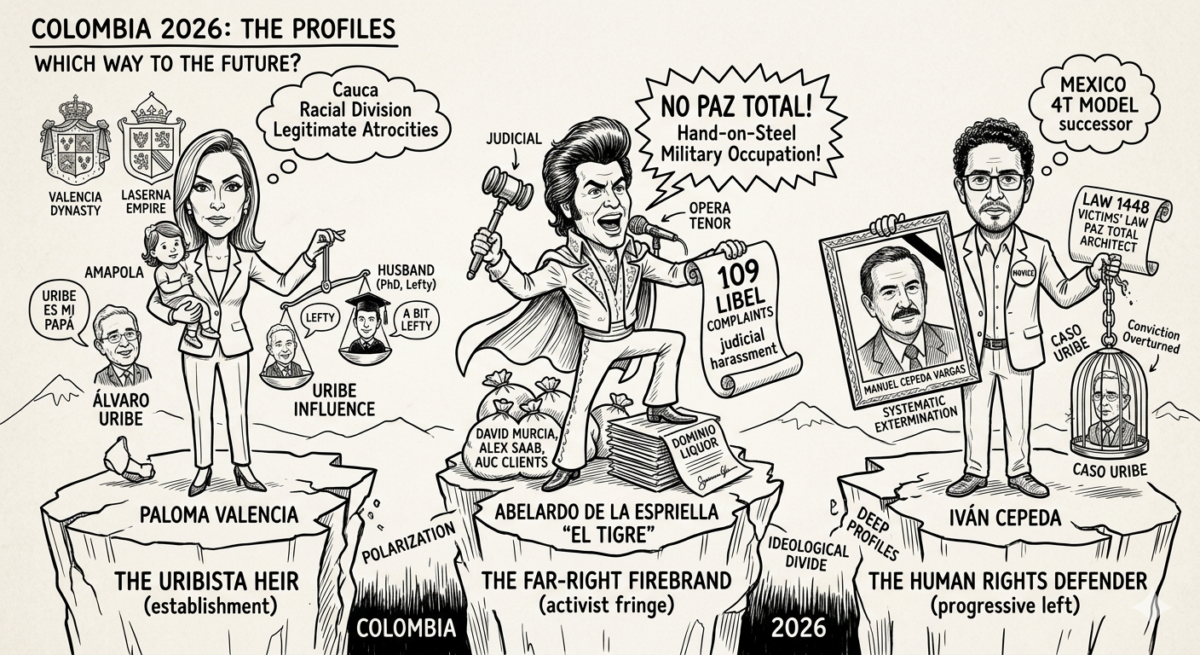
With Colombia’s presidential election just days away, voters face a fragmented field with three major candidates — Paloma Valencia (Centro Democrático / La Gran Consulta), Abelardo de la Espriella (Defensores de la Patria), and Iván Cepeda (Pacto Histórico) — each presenting a fundamentally different vision for the country’s future.
This article is based on the candidates’ actual published government plans, downloaded as PDFs from their official campaign websites. We compare them side by side across every major policy area, and analyze what the differences actually mean for Colombia.
1. Security & Public Order
| Policy | Paloma Valencia | Abelardo de la Espriella | Iván Cepeda |
|---|---|---|---|
| Approach | Return to Seguridad Democrática | “Pax Romana” — military occupation | Deepen Paz Total |
| New forces | 30K military + 30K police (~530K total) | Mobilize 82K reservists | Not specified |
| Spending | $20T COP over 4 years (4% of GDP) | $8-12T/year via Plan Colombia II | Not costed |
| JEP | Skeptical, would not expand | Eliminate entirely | Strengthen — Cepeda authored the framework |
| Peace process | No negotiations with armed groups | End Paz Total — bomb camps | Deepen negotiations |
| Coca policy | Aerial fumigation + forced substitution | 330K hectares fumigation | Substitution programs — opposes fumigation |
| Prisons | Rapid-response itinerant courts | 7 megaprisons (Bukele model) | Not specified |
Analysis
The three candidates occupy completely different positions on the security spectrum. De la Espriella’s plan is the most aggressive — military occupation, elimination of the peace framework, and mass incarceration. Valencia’s approach is a scaled-up version of Uribe-era policies. Cepeda’s is a continuation and deepening of the negotiating strategy he helped design. The key question: De la Espriella’s 90-day timeline is politically appealing but militarily unrealistic — even Uribe’s Seguridad Democrática took years.
2. State Reform & Corruption
| Policy | Paloma Valencia | Abelardo de la Espriella | Iván Cepeda |
|---|---|---|---|
| State size | Reduce ministries “al máximo” | Cut 40% — $25-30T/year savings | Maintain active state |
| Jobs | Consolidate agencies, no figure | Eliminate ~700K public jobs | Not specified |
| Anti-corruption | Digital state with AI oversight | Presidential search block, recover $20-25T/year | National System Against Macro-Corruption |
| Method | Gradual efficiency gains | “Motosierra” — emergency cuts | Republican austerity |
Analysis
De la Espriella’s 40% state cut is the single most radical proposal of any candidate — eliminating 700,000 jobs would require mass layoffs across every ministry. The $25-30T savings estimate assumes these cuts can happen without legal challenges or service collapse. Valencia’s approach is more measured but lacks specific targets. Cepeda’s plan is the opposite — state-led development with no reduction targets. The difference is philosophical: De la Espriella sees the state as the problem, Cepeda sees it as the solution, and Valencia is somewhere in between.
3. Tax & Economic Policy
| Policy | Paloma Valencia | Abelardo de la Espriella | Iván Cepeda |
|---|---|---|---|
| Corporate tax | Reduce (no rate specified) | No change — widen base | Keep progressive rates |
| Wealth tax | Eliminate | Not addressed | Keep and deepen |
| 4×1000 tax | Keep | Eliminate (conditional on 40% state cut) | Keep |
| Economic model | Free market + safety net | Libertarian — minimal state | State-led development |
| Jobs target | Implicit | 3M in 4 years | Implicit |
Analysis
Valencia and De la Espriella both want to lower the tax burden on businesses, but through different mechanisms — Valencia cuts rates directly, De la Espriella eliminates the 4×1000 (which costs $14T/year in revenue) and hopes growth fills the gap. Cepeda’s tax policy is the most redistributive, continuing Petro’s model of taxing wealth and oil profits to fund social programs. The unresolved tension: Valencia cuts taxes and increases spending without explaining how to balance the budget. De la Espriella has a revenue plan ($102-132T total) but it relies on optimistic assumptions. Cepeda doesn’t address costs at all.
4. Energy & Environment
| Policy | Paloma Valencia | Abelardo de la Espriella | Iván Cepeda |
|---|---|---|---|
| Fracking | FAVOR — reactivate exploration | FAVOR — $15-20T/year royalties | OPPOSE — complete rejection |
| Fossil fuels | Maximize production | Maximum expansion | Phase out within 15 years |
| Renewables | Hydroelectric + clean energy | Solar and wind revolution | Accelerate transition |
| Royalties | Not specified | $15-20T/year from hydrocarbons | Reinvest into transition |
Analysis
Valencia and De la Espriella both see hydrocarbons as Colombia’s path to economic growth — they differ only in degree, with De la Espriella promising $15-20T in annual royalties. Cepeda wants to end fossil fuel extraction entirely within 15 years, which would transform the Colombian economy but requires a credible transition plan that his PDF doesn’t provide. The irony: De la Espriella’s $15-20T royalty estimate accounts for a huge portion of his revenue plan. If global energy prices fall, his fiscal math collapses.
5. Healthcare
| Policy | Paloma Valencia | Abelardo de la Espriella | Iván Cepeda |
|---|---|---|---|
| EPS system | Maintain with stronger regulation | Audit and liquidate failing EPS | Eliminate — single public payer |
| Backlog | Resolve 10M appointments | Not specified | Not specified |
| Investment | Mass medicine purchase, UPC adjustment | $10T COP priority care | Continue Petro’s reforms |
Analysis
All three acknowledge the healthcare system is broken, but their solutions differ radically. Valencia works within the existing EPS framework. De la Espriella audits and liquidates failing ones. Cepeda wants to eliminate the EPS system entirely — the biggest healthcare reform since Law 100 in 1993. None provides a detailed transition plan for what happens in between.
6. Social Policy & Welfare
| Policy | Paloma Valencia | Abelardo de la Espriella | Iván Cepeda |
|---|---|---|---|
| Housing | 1M new homes | 2% loans over 30 years — 1M homeowners | Not specified |
| Poverty | Expand Colombia Mayor to 3M | “Colombia sin Hambre” — $2T/year, 12M | Expand social programs |
| Children | $500K savings seed for newborns | $600K/month for single mothers | Not specified |
| Education | School vouchers, STEM universities | 1,000 schools, dual degree | Free public through university |
| Social values | Conservative | Hard conservative | Progressive |
7. Foreign Policy
| Policy | Paloma Valencia | Abelardo de la Espriella | Iván Cepeda |
|---|---|---|---|
| United States | Pro-Trump, strengthen alliance | Strategic alliance — Plan Colombia II | Critical — reduce military cooperation |
| Venezuela | Anti-Maduro | Strong US alignment | Normalize relations |
| International orgs | OECD expansion | Review UN, OAS, CIDH membership | Diversify beyond US |
Revenue: Who Has a Fiscal Plan?
Only one candidate has published a detailed revenue table:
| Source (De la Espriella) | Annual COP trillions |
|---|---|
| State cut 40% | $25-30T |
| Anti-corruption recovery | $20-25T |
| Plan Colombia II | $8-12T |
| Hydrocarbon royalties | $15-20T |
| Legal mining royalties | $5T |
| 5% GDP growth | $15-20T |
| Special economic zones / FDI | $10-15T |
| Tourism (5M visitors) | $2-3T |
| Total | $102-132T |
Valencia: Only one costed item — $20T over 4 years for security. No revenue plan.
Cepeda: No revenue estimates in his 717-page document. His plan is a philosophical agenda, not a fiscal one.
Overall Comparison
| Domain | Valencia | De la Espriella | Cepeda |
|---|---|---|---|
| Economic model | Free market, lower taxes | Libertarian, minimal state | State-led, progressive taxes |
| State size | Reduce (no figure) | Cut 40% ($25-30T/year) | Maintain active state |
| Security | Seguridad Democrática | Pax Romana (bomb camps, megaprisons) | Paz Total (negotiations) |
| Healthcare | Reform within EPS | Audit + liquidate failing EPS | Eliminate EPS, single payer |
| Energy | Pro-fracking, maximize oil | Pro-fracking, $15-20T royalties | Anti-fracking, 15-year phaseout |
| Social | Conservative, targeted | Hard conservative, focalized | Progressive, universal |
| Foreign | Pro-Trump, anti-Venezuela | US-Israel alliance, leave UN/OAS | Pro-Mexico, diversify |
| Plan specificity | Medium — some numbers | High — detailed revenue plan | Low — philosophical |
| Fiscal plan? | One item costed | Yes — $102-132T/year | None |
Analysis: The Real Choice
The three candidates are not just offering different policies — they are offering different diagnoses of what Colombia’s core problem is.
Valencia: The Centrist-Conservative Model
Valencia offers a return to Centro Democrático orthodoxy — smaller government, lower taxes, stronger security — but with a social safety net expansion that Uribe never pursued. Her plan is politically the safest: it doesn’t threaten the existing institutional framework (EPS, JEP, Colpensiones) the way De la Espriella’s does. But it also doesn’t explain how to pay for tax cuts and spending increases simultaneously. The $20T security increase is the only costed line item in her entire 111-point plan.
De la Espriella: The Radical Transformation Model
De la Espriella’s plan is the most ambitious and the most risky. Cutting 40% of the state, eliminating the JEP, building 7 megaprisons, and generating $102-132T in new revenue all within four years would require a level of political capital and institutional control that no Colombian president has ever achieved. His revenue assumptions are optimistic — 5% GDP growth, $15-20T in hydrocarbon royalties, $20-25T recovered from corruption — and each one depends on factors outside presidential control. But he is the only candidate who has attempted to publish a fiscal plan at all. Valencia and Cepeda ask voters for a blank check.
Cepeda: The Progressive Continuity Model
Cepeda’s plan is not really a government program in the traditional sense — it’s a collection of 717 pages of speeches organized around themes, with no numbered proposals, no specific targets, and no cost estimates. His document is a political manifesto, not a fiscal plan. It is strongest on human rights, peace, and anti-corruption — his areas of expertise — and weakest on economics, administration, and implementation. A Cepeda presidency would mean continuing and deepening Petro’s agenda, but without the detailed roadmap that voters might expect.
Conclusion
The 2026 Colombian presidential election presents voters with three fundamentally different visions:
- Paloma Valencia believes Colombia’s problem is a weak state that has lost control of security and over-regulated the economy. Her solution: strengthen security forces and free markets, while expanding targeted social programs.
- Abelardo de la Espriella believes Colombia’s problem is a parasitic state. His solution: cut the state by 40%, eliminate the peace framework, and bet everything on deregulation and hydrocarbon royalties.
- Iván Cepeda believes Colombia’s problem is structural inequality and unfinished peace. His solution: expand the state to provide universal services and deepen the peace process he helped create.
None of these three candidates has published a fully costed, independently verifiable fiscal plan — though De la Espriella comes closest. Colombian voters will have to choose which diagnosis they trust, and which risks they are willing to take.
This comparison is based on the candidates’ official government plan PDFs: Paloma Valencia’s “111 Puntos del Plan de Gobierno” (palomavalencia.com), Abelardo de la Espriella’s “Propuestas y Programas de Gobierno” (LasillaVacia.com), and Iván Cepeda’s “Programa de Gobierno 2026-2030” (movimientopacto.co). Data as of May 25, 2026.