

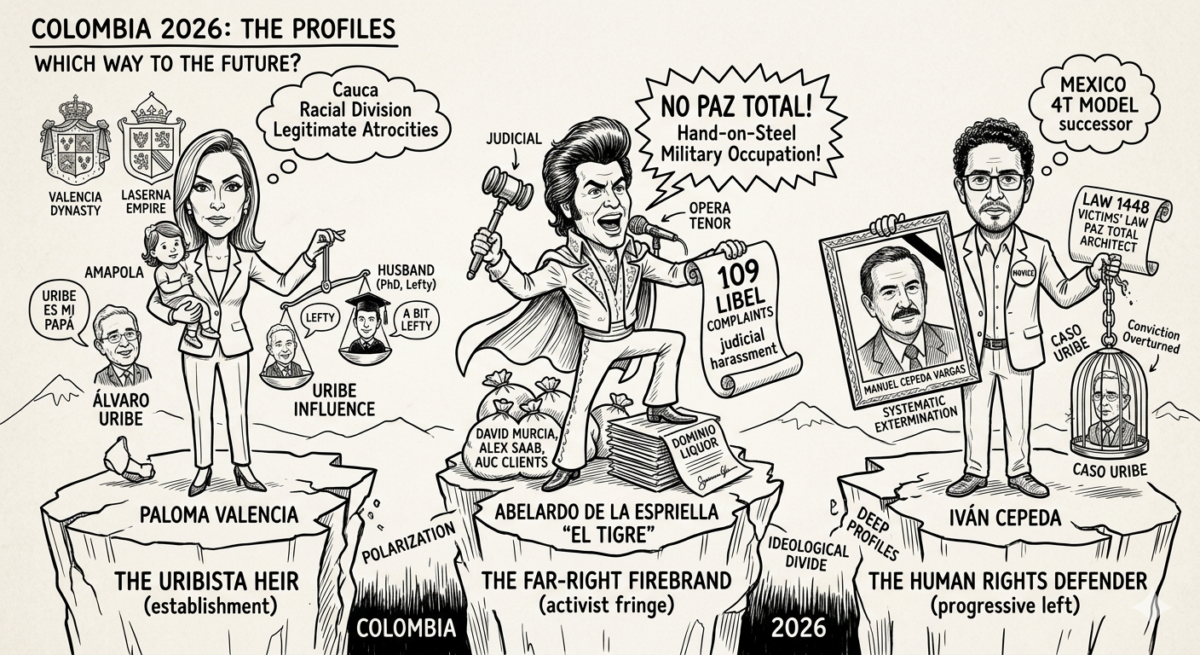
As Colombia approaches the 2026 presidential election, the field is taking shape across the ideological spectrum. This in-depth profile examines three candidates who represent distinct political traditions: the Uribista establishment, the far-right activist fringe, and the progressive human rights left.
PART ONE: PALOMA VALENCIA LASERNA
The Uribista Heir
“Uribe es mi papá” — Paloma Valencia, 2026 campaign speech
1. Personal Data
| Full name | Paloma Susana Valencia Laserna |
| Born | January 19, 1978 (age 48) — Popayán, Cauca |
| Residence | Bogotá |
| Religion | Catholic |
| Marital status | Married to Tomás Rodríguez Barraquer (PhD Economics, Stanford; professor at Universidad de los Andes; son of former Environment Minister Manuel Rodríguez Becerra). She describes him as “un poco mamerto” (a bit lefty) |
| Children | One daughter: Amapola Rodríguez Valencia |
2. Family Dynasty — The Valencia Political Empire
Paloma Valencia comes from not one but two of Colombia’s most powerful families:
- Great-grandfather (paternal): Guillermo Valencia — celebrated poet, congressman, Conservative presidential candidate (1930, lost to Olaya Herrera)
- Grandfather (paternal): Guillermo León Valencia — President of Colombia (1962–1966)
- Paternal aunt: Josefina Valencia — Colombia’s first female cabinet minister
- Father: Ignacio Valencia López — former congressman investigated for ties to the AUC paramilitaries
- Mother: Dorotea Laserna Jaramillo — producer of “La Hora de la Verdad” radio program (hosted by former minister Fernando Londoño)
- Maternal grandfather: Mario Laserna Pinzón — philosopher, founder of Universidad de los Andes, former ambassador
- Uncle (maternal): Juan Mario Laserna — former senator (Conservative Party)
- Cousin: Aurelio Iragorri Valencia — former Minister of Agriculture and Interior
Her father Ignacio Valencia was a Liberal Party congressman later investigated over paramilitary links (AUC). Her mother’s father founded Colombia’s most prestigious private university. Two dynasties, one politician.
3. Education — Three Degrees at Los Andes + NYU
Paloma Valencia studied three separate fields at Universidad de los Andes:
Law degree (Abogada)
Philosophy degree (studied simultaneously with law)
Economics specialization
Master’s in Creative Writing — New York University (NYU)
This is an unusually broad academic profile for a Colombian politician — most enter politics with one degree. The creative writing master’s at NYU is particularly unusual and suggests an intellectual-literary ambition that never fully materialized (she went into politics instead).
4. Before Politics — Media Career
Before electoral politics, Valencia worked in media:
- Columnist for *El Espectador* and *El País de Cali*
- Political analyst on *Blu Radio* — major Colombian news radio
- Founder of digital portal *La Otra Esquina*
- Worked on her mother’s radio program “La Hora de la Verdad” — hosted by Fernando Londoño
This gave her a public profile before she ever held office.
5. How She Entered Politics
2002–2006: Conservative Party — her first affiliation, tracking family tradition.
2006: First campaign — Alas Equipo Colombia (LOSS)
She ran for the Chamber of Representatives in Bogotá under Luis Alfredo Ramos’ party, a center-right movement offering a fresher platform than the traditional Conservatives.
Result: 1,656 votes — not elected. Her only electoral loss.
2013: Founding of Centro Democrático
When Uribe created Centro Democrático after breaking with Santos over the peace talks, Valencia joined as a founder — one of the original Uribe loyalists.
2014: Election to the Senate
She ran 3rd on Uribe’s closed list and was elected. She took office July 20, 2014.
6. First Senate Term (2014–2018) — Learning the Ropes
2015: The Cauca Division Proposal
In Santander de Quilichao, Valencia proposed splitting Cauca into two departments: one for indigenous communities, one for mestizos. Her exact words: “One indigenous, so they can have their strikes, protests and invasions, and one with a development vocation where we can have roads, investment, and dignified employment.”
Widely called racist. She defended it as consistent with the 1991 Constitution. First major controversy.
2016: Leader of the “No” Campaign
She was one of the most visible national leaders of the No campaign against the FARC peace accord. When No won 50.2%, she was among the opposition claiming vindication.
Within Centro Democrático, she was “one of the most ideological senators” (La Silla Vacía) — not a backbencher.
7. Second Senate Term (2018–2022) — The Duque Years
Her most active and controversial term.
June 2018: The False Uribe Arrest Claim
She tweeted that the Supreme Court was planning to arrest Uribe to prevent Duque’s judicial reform. The Supreme Court issued an official communiqué calling her statements “disrespectful and irresponsible” and denying any arrest plan. She presented no evidence. The incident damaged her credibility but showed her willingness to go to extremes for Uribe.
October 2018: The 20% Salary Proposal
“Why don’t graduates co-finance education, contributing 20% of their salary for 10 years?”
Massive backlash from students and rectors. She clarified it was meant as “voluntary” — but the damage was done.
November 27, 2018: The Petro Video
During a Senate debate on Odebrecht, Valencia showed video of Petro receiving cash from his former official Juan Carlos Montes. She suggested the money came from Diosdado Cabello or Odebrecht, but presented no evidence.
Petro explained it was 2005 campaign contributions — legal at the time. In 2021, the Supreme Court archived the case finding no evidence of illegal acts. La Silla Vacía fact-check rated her interpretation as “imprecise.”
2020: President of the Senate
Elected President of the Senate for the 2020-2021 legislative year — the highest institutional role of her career. She managed legislative debates, set the agenda, and represented the Senate. La Silla Vacía notes she “built bridges with congresspeople from other benches” during this period.
2021: National Strike (Estallido Social)
Hardline position. Supported military and police response. Opposed negotiations with protesters she called “vandals.”
Legislative achievements:
- Ley de la Panela — formalizing panela sector
- Ley Escalera de la Formalidad — gradual business formalization
- Her two “bandera” (flagship) laws per La Silla Vacía
2022: Re-election
Won Senate re-election with 63,559 votes — more than double her 2018 result of 29,208.
2022 Presidential Precandidacy
Lost the internal party poll to Óscar Iván Zuluaga. Pivoted to Senate re-election.
8. Third Senate Term (2022–2026) — Opposition to Petro
July 2022: “Legitimate Atrocities” Statement
“The State made mistakes and atrocities, but it was legitimate and fundamentally it was in defense of citizens.”
Senator Angélica Lozano: “The crimes of public servants are more serious because they break the legitimacy of the State.” David Racero accused her of ignoring international humanitarian law.
Opposition to Petro’s reforms:
- Tax Reform: Led opposition, helped sink it. Challenged Petro’s economic emergency decree as unconstitutional.
- Health Reform: Participated in rare direct talks between Centro Democrático and the government — including Uribe in person.
- Pension & Labor reforms: Opposed as party line.
March 2025: Deyanira Gómez Defamation Case
Valencia posted on X that Dr. Deyanira Gómez — a key witness in the Uribe witness-tampering case — was “married to a FARC commander.” Gómez’s lawyer filed a criminal defamation complaint before the Supreme Court. The Court summoned Valencia to a conciliation hearing on April 1, 2025. Still pending.
9. The 2026 Presidential Campaign
Centro Democrático started with five pre-candidates. The campaign was marked by the assassination of Miguel Uribe Turbay, a rival candidate. After his death, his father briefly entered then exited the race.
Uribe personally structured two internal polls that selected Valencia as the candidate.
March 8, 2026: La Gran Consulta por Colombia
She won with 3,248,589 votes (55.36%, 1st place) — unifying the center-right.
Platform:
- Security: Return to Seguridad Democrática
- Economy: Lower taxes, less state
- Energy: Pro-fracking, relaunch fossil fuels
- Social: Anti-abortion, anti-same-sex marriage
- Foreign: Pro-Trump, supported US bombing of Venezuela (Jan 2026). Petro called her a “traitor to the Fatherland”
- Proposed Álvaro Uribe as Minister of Defense
10. Relationship with Álvaro Uribe
Uribe has been her political mentor since 2014. The relationship is exceptionally close:
- “Uribe es mi papá” — campaign speech
- Proposed him as Defense Minister
- Attacked his accuser Deyanira Gómez — faces defamation case
- Falsely claimed Supreme Court would arrest him (2018)
- Selected via “two internal polls structured personally by Uribe” (La Silla Vacía)
Asset: Uribe’s base. Liability: she’s seen as his proxy.
11. Personality & Reputation
Strengths (per journalists):
- Ideologically driven — one of CD’s most principled senators
- High social media reach — among most-followed CD politicians
- Bridge-builder — cross-bench relationships, especially as Senate president
- No corruption scandals — La Silla Vacía explicitly notes this
- Intellectual breadth — law, philosophy, economics, creative writing
Weaknesses:
- Perceived as extreme — Cauca racial division, “legitimate atrocities”
- Credibility issues — false Uribe arrest claim, Petro video
- Uribe’s proxy image — “Uribe es mi papá” reinforced this
- Defamation exposure — Deyanira Gómez case pending
Rivalry with María Fernanda Cabal: Both ran for the same nomination. Cabal is more visible and hardline. Uribe chose Valencia.
12. Specific Voting Record
| Issue | Position | Detail |
|---|---|---|
| 2016 Peace Accord | NO | Visible national leader of No |
| Petro’s Tax Reform | AGAINST | Led opposition, helped sink it |
| Petro’s Health Reform | OPPOSED | Participated in talks but opposed |
| Abortion (decriminalization) | OPPOSES | Anti-abortion in platform |
| Same-sex marriage | OPPOSES | Conservative position |
| Fracking | FAVOR | Wants to relaunch extraction |
| JEP extensions | SKEPTICAL | Opposes mandate expansion |
| 2021 protests | HARDLINE | Supported military response |
13. 2026 Prospects
Valencia is the leading right-wing establishment candidate. She won the Gran Consulta with 3.25M votes, but trails independent right-winger Vicky Dávila in national polls (Dávila at ~25-30%).
Per Guarumo (May 2026), Valencia reached her highest polling levels ever — surpassing Iván Cepeda in a runoff projection for the first time.
Key challenge: The right is fragmented three ways: establishment (Valencia), independent (Dávila), far-right fringe (de la Espriella, Cabal). If it unifies, she’s competitive. Divided, the center or left could slip through.
PART TWO: ABELARDO DE LA ESPRIELLA
The Far-Right Firebrand
“No hay en la historia de Colombia, la amnistía general que ha hecho @petrogustavo a los narcos y delincuentes de las Farc, Eln y disidencias. Los colombianos no lo van a aceptar” — Abelardo de la Espriella, X, 2026
1. Personal Data
| Full name | Abelardo Gabriel de la Espriella Otero |
| Born | July 31, 1978 (age 47) — Bogotá, Colombia |
| Nickname | “El Tigre” |
| Nationalities | Colombian, American (US permanent resident), Italian |
| Religion | Atheist until 2020 → Catholic convert (2021) |
| Marital status | Married to Ana Lucía Pineda (since 2008) |
| Children | Four: Lucía, Salvador, Filippo, Francesca de la Espriella Pineda |
2. Family Background
- Father: Abelardo de la Espriella Juris
- Mother: María Eugenia Otero Aldana
- Spent childhood and adolescence in Montería, Córdoba
- Attended Colegio La Salle de Montería (graduated 1994)
3. Education
- Universidad Sergio Arboleda — Law degree (graduated 2000); also Master’s in Law
- Universidad Externado de Colombia — Postgraduate in Criminal Law and Criminology
- Universidad del Rosario — Postgraduate in Administrative Law
- Universidad Autónoma del Caribe — Doctor Honoris Causa in Law (2016)
- Federación Iberoamericana de Abogados (FIA) — International Doctor Honoris Causa (2022)
Note: Despite what some sources claim, de la Espriella is a criminal defense lawyer, not a notary. There is no evidence he ever worked as a notary public.
4. Career as a Defense Lawyer
Founded De la Espriella Lawyers Enterprise in 2002, formally incorporated in 2004, with offices in Colombia and the US (Florida). His client list reveals his political and legal positioning:
High-profile clients:
- David Murcia Guzmán — founder of DMG, a pyramid scheme that defrauded over 200,000 Colombian savers
- Jorge Pretelt — former Constitutional Court magistrate convicted in the Fidupetrol corruption case
- Alex Saab — alleged money launderer for Nicolás Maduro (represented 2013–2019; his US firm lacked an OFAC license for the US case)
- Álvaro Uribe Vélez — defended Uribe after his 2025 conviction for witness tampering and procedural fraud
- Members of paramilitary groups linked to the parapolitics scandal (2007)
- Natalia Ponce de León — acid attack victim (pro bono)
- Rosa Elvira Cely — femicide victim’s family (pro bono)
Business empire (35 companies across Colombia, Panama, USA):
- 7 active Colombian companies: De la Espriella Lawyers, De la Espriella App, Cosenza, De la Espriella Style, Dominio De la Espriella (liquor), Mediterráneo Corp, Northwest SAS
- Combined 2024 revenues: COP $16,130 million (~$4M)
- Net result (2024): COP -159 million (losses)
- Patrimony (equity): COP $19,680 million (~$5.2M)
- US properties: Miami mansion ($5.1M) + second property ($628K)
- Colombian properties: 19 properties (apartments, lots, farms, warehouses) held through companies
- Dominio De la Espriella (liquor): COP -$3,381M negative equity
- De la Espriella Style (clothing): COP -$230M negative equity
- Only De la Espriella Lawyers (COP $16,531M equity) and Cosenza (COP $5,817M) are profitable
He also sings opera as a tenor: released “O Sole Mío” (2018) and album “Navegante” (2022).
5. Transition to Politics
Unlike traditional Colombian politicians who rise through local office, de la Espriella entered politics directly as a presidential candidate. He built his political profile through:
High-profile criminal cases — defending controversial figures (Murcia, Saab, Uribe)
Social media — aggressive, confrontational style
The 2016 “No” campaign — actively campaigned against the FARC peace accord, providing legal arguments alongside Álvaro Uribe and Centro Democrático
Legal actions against journalists — the FLIP (Freedom of Press Foundation) has warned about his use of judicial harassment against journalists. Between 2008–2019, he filed 109 criminal complaints for calumny and libel, most dismissed or withdrawn
6. Political Movement
- Movimiento de Salvación Nacional (National Salvation Movement) — led by Enrique Gómez Martínez, endorsed de la Espriella’s campaign
- “Defensores de la Patria” (Defenders of the Homeland) — his own movement
- He originally attempted to use the name “Colombia Humana” (registered by Gustavo Petro); lost the legal dispute and the right to use the name
7. 2026 Presidential Campaign
Signatures collected: Presented 5,079,000; 1,978,108 accepted (62% invalid rate, but still the highest accepted count among signature-based candidates)
Running mate: José Manuel Restrepo — former Minister of Commerce and Finance under Iván Duque
Funding network (per La Silla Vacía):
- His own business empire (self-financing claim)
- Silvestre Dangond — vallenato singer, partner in Ron Defensor
- Serafino Iácono — oil businessman, partner in Dominio De la Espriella
- Federico Restrepo Solano — oil businessman
- Héctor Amaris (“Oso Yogui”) — controversial figure, ex-associate of Barranquilla mayor Alejandro Char
- Aniano Iglesias — lawyer, linked to narco-asset holdings
- Juan Carlos Gossaín — former governor of Bolívar, disqualified for corruption
Support base: Business owners, military/police reserves, Christian right (evangelical pastors), hardline anti-Petro voters
8. Policy Platform
| Issue | Stance |
|---|---|
| Security | “Mano dura” — end all peace processes, close the JEP, military occupation |
| Peace process | Total rejection of Paz Total and 2016 accord; “the only real peace was that of the paramilitaries” |
| Economy | Free market, eliminate ministries, reduce the state |
| International | Withdraw from UN, OAS, CIDH (Inter-American Court). Restore relations with Israel |
| Gun rights | Pro-civilian gun ownership |
| Abortion | Opposes |
| LGBTQ rights | Opposes same-sex adoption, anti-feminist |
| Euthanasia | Opposes |
| Venezuela | Strongly anti-Maduro. Wants to restore relations with Israel |
| US relations | Pro-Trump, far-right alignment |
| Religion | Courts Christian right, personal Catholic convert (2021) |
9. Controversies
| Issue | Detail |
|---|---|
| 109 libel complaints | Filed against journalists (2008–2019) — FLIP calls this judicial harassment |
| Alex Saab representation | Represented Maduro’s alleged frontman; his US firm lacked OFAC license |
| David Murcia accusations | Former client (DMG pyramid scheme founder) accused him of stealing COP $5 billion from prison (Feb 2026) |
| Campaign coordinator killed | A coordinator was assassinated in Meta; de la Espriella denounced a plot to kill him with snipers |
| Name dispute with Petro | Tried to register “Colombia Humana” as his party name; lost in court |
| Failed ballot attempts | Previous attempts to reach ballot failed due to insufficient signatures |
10. Relationship with Other Right-Wing Figures
- Álvaro Uribe: Close defender — organized marches supporting Uribe after his 2025 conviction; tried to take down the “Matarife” documentary exposing Uribe’s paramilitary ties
- Paloma Valencia: They compete for the Christian vote — El Tiempo (May 2026): “Paloma Valencia and Abelardo de la Espriella divide the Christian vote — the Uribismo keeps MIRA, the lawyer gets the most radical”
- Vicky Dávila: Shares the same far-right lane but Dávila is the frontrunner
11. 2026 Prospects
De la Espriella is a minor candidate (polling 1–5%). His main challenge is that the right is already crowded with more established names. He retains a vocal base among hardline anti-Petro voters and the Christian right, but his organizational capacity is unproven and his provocative style limits his appeal beyond the far-right fringe.
PART THREE: IVÁN CEPEDA CASTRO
The Human Rights Defender
“Mi padre no fue asesinado para que yo me callara” — Iván Cepeda
1. Personal Data
| Full name | Iván Cepeda Castro |
| Born | October 24, 1962 (age 63) — Bogotá, Colombia |
| Religion | Not publicly declared |
| Marital status | Married to Blanca del Pilar Rueda (advisor at the JEP’s UIA since 2018). Previously married to Claudia Girón |
| Children | Information not publicly available |
2. Family Tragedy — The Assassination of Manuel Cepeda Vargas
The defining event of Iván Cepeda’s life came before he entered politics:
- Father: Manuel Cepeda Vargas (born April 13, 1930, Armenia) — senator, member of the Unión Patriótica (UP)
- Mother: Yira Castro — concejal of Bogotá for the UNO, prominent communist leader (died August 1981)
- Sister: María Cepeda Castro
The assassination: On August 9, 1994, Manuel Cepeda Vargas was shot dead by sicarios on motorcycles on Avenida Las Américas in Bogotá. He was part of the systematic extermination of the Unión Patriótica — over 6,000 party members were killed in Colombia’s genocide against the left.
Convictions:
- Two ex-Army sub-officers (Hernando Medina, Justo Gil Zúñiga) were sentenced to 43 years in 2001
- Paramilitary leaders Don Berna and Jesús Emiro Pereira were also implicated
- The Inter-American Court of Human Rights condemned Colombia in 2010
- The State formally apologized in 2011
- In 2014, Colombia’s Fiscalía declared the UP extermination a crime against humanity
This event radicalized Cepeda toward human rights work and later, toward the investigations that would bring him into direct confrontation with Álvaro Uribe.
3. Education
- Colegio Camilo Torres (Bogotá) — primary and secondary
- Universidad San Clemente de Ohrid (Sofia, Bulgaria) — studied Philosophy
- Université Catholique de Lyon (France) — Master’s in Human Rights (completed during exile, 2000–2003)
4. Career Before Politics
1994: One day after his father’s assassination, Cepeda founded the Fundación Manuel Cepeda Vargas to defend human rights and pursue justice for victims of state crimes.
1994–2000: He worked as a human rights defender in Colombia while receiving death threats for his investigations into paramilitary and state violence.
2000–2003: Exiled to France after credible death threats. Completed his Master’s in Human Rights at Lyon.
2003: Co-founded MOVICE (Movimiento de Víctimas de Crímenes de Estado) — the National Movement of Victims of State Crimes. This became Colombia’s most important victims’ rights organization.
2005: Taught Aesthetics at Universidad Javeriana (briefly).
5. Political Career
Party affiliation:
- Unión Nacional de Oposición (UNO) — early affiliation
- Polo Democrático Alternativo (PDA) — since 2005
- Pacto Histórico — since 2022 (the governing coalition)
Electoral history:
| Year | Position | Coalition | Votes | Result |
|---|---|---|---|---|
| 2010 | Chamber of Rep. (Bogotá) | Polo Democrático | 23,761 | ✅ Elected |
| 2014 | Senate | Polo Democrático | 35,057 | ✅ Elected |
| 2018 | Senate (re-election) | Lista de la Decencia | 88,962 | ✅ Elected |
| 2022 | Senate (re-election) | Pacto Histórico | 143,801 | ✅ Elected |
| 2026 | Pacto Histórico primary | Pacto Histórico | ~1.5M (65%) | ✅ 1st place |
Senate roles:
- Senator since 2014 (three consecutive terms)
- President of the Senate Peace Commission
- Member of human rights and justice committees
- Congressional rapporteur for Paz Total legislation
6. Key Legislative Achievements
- 2011 Victims’ Law (Law 1448) — one of the world’s most comprehensive frameworks for victim reparation and land restitution. Cepeda was instrumental through MOVICE advocacy and his congressional work.
- Legal Framework for Peace (JEP creation) — co-author of the constitutional framework that created the Special Jurisdiction for Peace
- Reform to Ley de Orden Público — enabling Paz Total negotiations
- Regulation of police use of force in protests — post-2021 estallido social
- Military/police promotion system reform — transparency measures
- Social service for peace — alternative service program
- Censura motions: Successfully moved censure against Defense Minister Diego Molano (2021) and Carlos Holmes Trujillo (2020)
7. The Uribe Investigations — “Caso Uribe”
This is the most consequential legal-political story of Cepeda’s career.
Timeline:
- April 2012: As a Representative, Cepeda held a control debate on paramilitarism in Antioquia, directly implicating Uribe
- September 2014: A Senate debate led Uribe to publicly accuse Cepeda of witness tampering — offering benefits to former paramilitaries to testify against Uribe
- Supreme Court investigation: The Court investigated Cepeda’s conduct and cleared him completely. But the investigation shifted — the Court found that Uribe’s own lawyer, Diego Cadena, had been tampering with witnesses to discredit Cepeda’s allegations
- August 2025: Álvaro Uribe was convicted of witness tampering and procedural fraud and sentenced to 12 years in prison
- October 2025: The Tribunal Superior de Bogotá overturned the conviction on appeal
- Current status: Cepeda filed a cassation appeal; the case is still pending before the Supreme Court
The Deyanira Gómez subplot: Cepeda’s key witness Deyanira Gómez was attacked on X by Paloma Valencia, leading to a criminal defamation complaint — showing how this case continues to reverberate through the 2026 campaign.
8. Relationship with Gustavo Petro
Cepeda is Petro’s chosen successor. Key indicators:
- Petro personally endorsed Cepeda as Pacto Histórico’s presidential candidate
- Cepeda was the principal architect of Paz Total, Petro’s signature policy
- He served as the government’s congressional rapporteur for peace negotiations
- Cepeda called a massive rally on February 3, 2026 to support Petro’s US visit
- He campaigns on continuing Petro’s “salario mínimo vital” (living minimum wage) revolution
However, this closeness is also a vulnerability. Petro’s approval rating has declined to ~35–40%, making a “continuity” pitch harder to sell.
9. Internal Pacto Histórico Dynamics
Cepeda won the October 2025 Pacto Histórico primary with 65% of the vote (~1.5 million votes). His main internal rivals:
- María José Pizarro — senator, daughter of M-19 commander Carlos Pizarro; another progressive candidate who represents the younger faction
- David Racero — former president of the Chamber of Representatives; Morena-aligned
- Frente por la Vida — a faction within the coalition that tried to block Cepeda’s participation in primaries (blocked by the CNE)
Cepeda’s position: he represents the human rights / progressive left wing of Pacto Histórico, as distinct from the more radical or Morena-aligned factions.
10. 2026 Campaign Platform
Cepeda’s platform is heavily inspired by Mexico’s 4T (Cuarta Transformación) — the AMLO/Sheinbaum model:
- Increase Colombia Mayor from 3 million to 5 million beneficiaries (elderly subsidy)
- Continue raising the minimum wage — Petro’s policy of above-inflation increases
- Increase youth and family subsidies
- Fight neoliberal economic policies
- Maintain Paz Total — continue negotiations with remaining armed groups
He has international ties with Claudia Sheinbaum and Morena in Mexico.
11. Books Written
- *”Duelo, memoria, reparación”* (1998, with Claudia Girón)
- *”Procesos de inculturación”* (1999, with Claudia Girón)
- *”Regresan siempre en primavera”* (2005, with Maribel Wolf)
- *”A las puertas de El Ubérrimo”* (2008, with Jorge Rojas)
- *”Víctor Carranza, alias ‘El Patrón’”* (2012, with Javier Giraldo) — on Colombia’s “emerald czar”
- *”Por las sendas del Ubérrimo”* (2014, with Alirio Uribe)
- *”Álvaro Uribe y la derecha transnacional”* (2015, with Felipe Tascón)
12. Policy Positions
| Issue | Stance |
|---|---|
| Peace process | Architect of Paz Total; supports negotiations with ELN and other groups |
| Security | Rejects mano dura; favors negotiations and truth commissions |
| Victims’ rights | His defining issue — author of historic legislation |
| Venezuela | Follows Petro line; does not formally recognize Maduro but critical of US intervention |
| Israel/Palestine | Vocal critic of Israeli human rights violations |
| US relations | Critical of Trump; seeks alignment with Mexico/Latin American progressives |
| Fracking | Opposes, advocates for environmental justice |
| Drug policy | Critical of DEA; supported Santrich against entrapment claims |
| Abortion | Progressive (Pacto Histórico platform supports women’s rights) |
| LGBTQ rights | Supports |
| Economy | Social democratic — higher minimum wage, expanded subsidies, state investment |
13. Controversies and Criticisms
| Issue | Detail |
|---|---|
| “Political persecution” of Uribe | Opponents claim his investigations are a personal vendetta for his father’s death. He denies this, citing documented evidence |
| Raúl Reyes computer controversy | FARC computer files used in some of Cepeda’s investigations; Interpol certified no tampering, but Colombian courts ruled chain-of-custody inadmissible |
| Gen. Nicacio Martínez retraction | Cepeda had to retract accusations against a general regarding extrajudicial executions (2020) |
| Defended Jesús Santrich | Took Santrich’s side against DEA entrapment claims; Santrich later rearmed with a FARC dissident group |
| Paz Total failure rate | Critics point to ELN negotiations stalling and dissident groups expanding under Paz Total |
14. International Recognition
- European Parliament Human Rights Prize (2021)
- Multiple resolutions from the Inter-American Court of Human Rights citing his work
- International ties with Claudia Sheinbaum and Mexico’s Morena party
15. Polling and 2026 Prospects
Cepeda won the Pacto Histórico primary with 65% (~1.5M votes) but is trailing in national polls:
- National polling: 4–6% (early 2026)
- Vicky Dávila leads most polls at 25–30%
- Polymarket (May 2026) showed Cepeda at 42% vs Abelardo de la Espriella at 49% in a runoff — suggesting his ceiling may be higher if he reaches a second round
His key challenge: Petro’s declining popularity. If the election is a referendum on the current administration, Cepeda carries that weight. But if the left unifies behind him and he makes it to a runoff, his polling suggests he could be more competitive than the first-round numbers indicate.
Comparison: Three Candidates at a Glance
| **Paloma Valencia** | **Abelardo de la Espriella** | **Iván Cepeda** | |
|---|---|---|---|
| Age | 48 | 47 | 63 |
| Party | Centro Democrático | Defensores de la Patria | Pacto Histórico |
| Ideology | Uribista conservative | Far-right / Trumpist | Progressive / human rights |
| Political lineage | Daughter of a president’s son | Self-made lawyer | Son of assassinated senator |
| Base | Conservative, rural | Christian right, military reserves | Victims, left, progressives |
| Key backer | Álvaro Uribe | Self-financed + oil businessmen | Gustavo Petro |
| Main issue | Security, anti-Petro | End peace process, anti-Petro | Social justice, Paz Total |
| Primary result | 3.25M (Gran Consulta) | 1.98M signatures | ~1.5M (Pacto primary) |
| National polling | ~8–12% | 1–5% | 4–6% |
| Biggest liability | Father’s paramilitary ties, divided right | Polarizing style, org issues | Petro’s unpopularity |
| Fracking | ✅ FAVOR | Likely FAVOR | ❌ OPPOSES |
| Abortion | ❌ OPPOSES | ❌ OPPOSES | ✅ SUPPORTS |
| Peace process | ❌ OPPOSES | ❌ OPPOSES | ✅ ARCHITECT |
| Venezuela | Pro-US intervention | Anti-Maduro | Neutral/critical |
| US relations | Pro-Trump | Pro-Trump | Pro-Mexico/Left |
This article was compiled from publicly available sources including Wikipedia ES, La Silla Vacía, Semana, El Tiempo, El Espectador, Congreso Visible, Infobae, Deutsche Welle, Colombia Reports, and FLIP. Bogotá Times does not endorse any candidate.
Last updated: May 21, 2026