

The apartments are getting smaller
Here is another trend worth noticing: as prices go up, square meters go down.
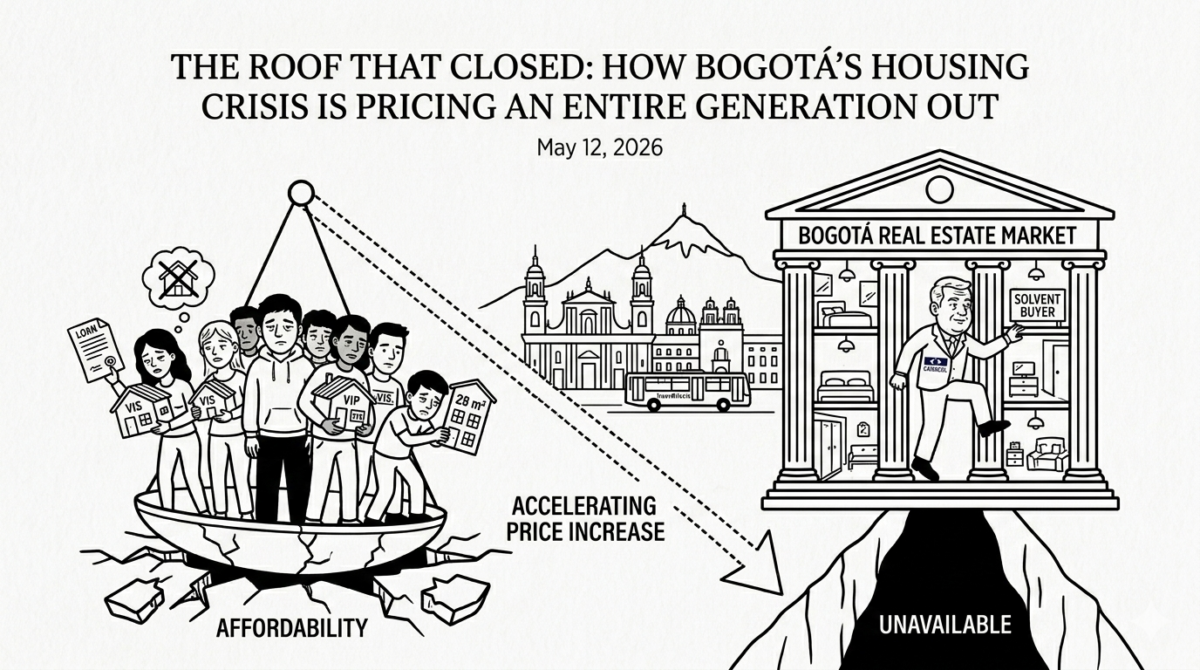
Developers are building smaller units to keep the ticket price within VIS limits. A “social interest” apartment in 2000 was 60-70m². By 2025, developers are squeezing VIS units into 40-45m². Some “micro-apartments” in Chapinero and Teusaquillo hit the market at 28m² and sell for $180 million.
Camacol, Colombia’s construction chamber, argues this is a necessary response to land prices. And they’re not entirely wrong. Land in Bogotá has appreciated faster than construction costs. But the result is the same: young people are paying more for less space.
What the government says
The national government’s main housing program is Mi Casa Ya, which provides a subsidy of up to 30 minimum wages ($42 million) for VIS housing plus a cobertura de tasa (interest rate coverage). In theory, this makes mortgages more accessible.
In practice, Mi Casa Ya has been plagued by budget shortages, delayed disbursements, and confusion about eligibility. In 2024 alone, the program ran out of funds mid-year, leaving thousands of approved applicants in limbo.
The District government (Alcaldía de Bogotá) has its own programs through the Secretaría de Hábitat, focused on subsidized rent and legalization of informal settlements. Mayor Carlos Fernando Galán’s administration promised 72,000 housing solutions over four years — but critics note most of these are in the “legalization and improvement” category, not new affordable units.
Neither level of government addresses the core problem: housing prices are rising faster than incomes, and the gap is accelerating.
What Camacol says
Camacol’s position, repeated in multiple reports and interviews, is that the real bottleneck is supply. They argue that Bogotá faces serious constraints on new construction — complex licensing processes, limited developable land, high tax burdens on formal construction, and uncertainty from national policy changes.
Their proposed solutions: streamline licensing, reduce construction taxes, and open new development zones through POT (Plan de Ordenamiento Territorial) revisions.
Critics point out that Camacol represents large developers, and their preferred solutions conveniently involve more deregulation and less social obligation. Not once has Camacol proposed mandating a percentage of truly affordable units in new projects.
The generation trapped in between
Housing in Bogotá creates a peculiar kind of generational trap.
People between 20 and 40 — the millennials and older Gen Z — are the ones most affected. They are too old to qualify for youth programs, too young to have accumulated decades of savings or family wealth. Their parents, if they are middle-class, probably bought their apartment in the 1990s or early 2000s, when prices were still connected to reality.
That door is closed now.
- Shared apartments well into your 30s
- Long commutes from the periphery
- Adult children living with parents indefinitely
- Emigration — many young professionals leave Bogotá for Medellín or abroad, citing housing costs as a top reason
- Informal housing in precarious settlements on the city’s edge
Data from the 2025 DANE quality of life survey confirms that Bogotá has one of the highest rates of “hogares multigeneracionales” (multiple generations in one house) in the country. This is not a cultural preference. It is a survival strategy.
What would actually fix it?
Housing crises don’t have simple solutions, but a few things are clear:
- The gap between wages and prices is structural. No subsidy program can fix this without addressing the root cause — land speculation and construction costs.
- Bogotá needs a serious land value capture policy. When the city builds infrastructure (TransMilenio lines, parks, metro stations), land prices in the area skyrocket — and the profit goes to private developers, not the public. Capturing some of that value to fund social housing is standard practice in cities like São Paulo, London, and Vienna.
- Rental regulation matters. Colombia has almost no effective rent control. In a city where rental inflation regularly outpaces wage growth, this is a crisis accelerator.
- Non-market housing. Vienna has 60% social housing. Singapore has 80%. Bogotá has less than 2%. Until the city starts treating housing as a public good rather than an investment vehicle, the crisis will continue.
The future
The median age in Bogotá is 30. The generation that will inherit the city is already priced out of it. Every year that passes without serious policy changes makes the problem worse — because housing prices don’t stay flat, and wages don’t catch up.
In 2035, Ana Martínez will be 40. She will probably still be living with roommates, or in a 28m² micro-apartment in a distant suburb, paying 50% of her salary for the privilege.
Unless something changes.
The question is whether Bogotá’s politicians and developers will acknowledge that the housing market is not working for a generation — or whether they will keep building tiny apartments at unaffordable prices and calling it a solution.